
I had a video interview this week with an NPR radio program called Science Friday. They will be talking on the air today about 3D printing, around 2:50pm EST and will direct people to check out the video on their website [ScienceFriday.com]. Check it out below!
Via ScienceFriday
Today I was interviewed/videotaped (and my machine) for a program called Science Friday. A portion of it will air on the radio on NPR this Friday around 2:50pm EST and then the video will be on their website; sciencefriday.com. Be sure to check it out!
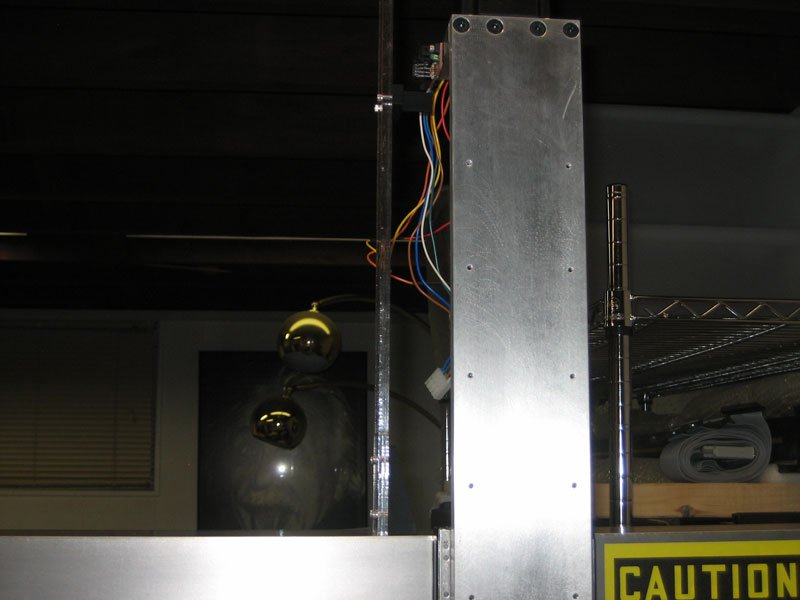
Upper Z Axis Endstop Flag
In the above image is the upper Z axis end stop flag which prevents the tool head from crashing into the build base. Each axis uses optical end stops, so when a flag breaks the beam on an end stop, the motor halts. The flag and right angle bracket (black) were printed on a commercial 3D printer. The translucent vertical piece is laser cut acrylic and serves as an adjustable mount for the flag. The length of this acrylic piece is necessary to accommodate the Z beam/Axis being mounted at different heights, so the flag can be set depedning on this height. For example, if the Z beam/Axis is set very low, say if we were doing some milling, this Flag would be set very high on the Acrylic piece to keep the tool head from crashing into the build table.
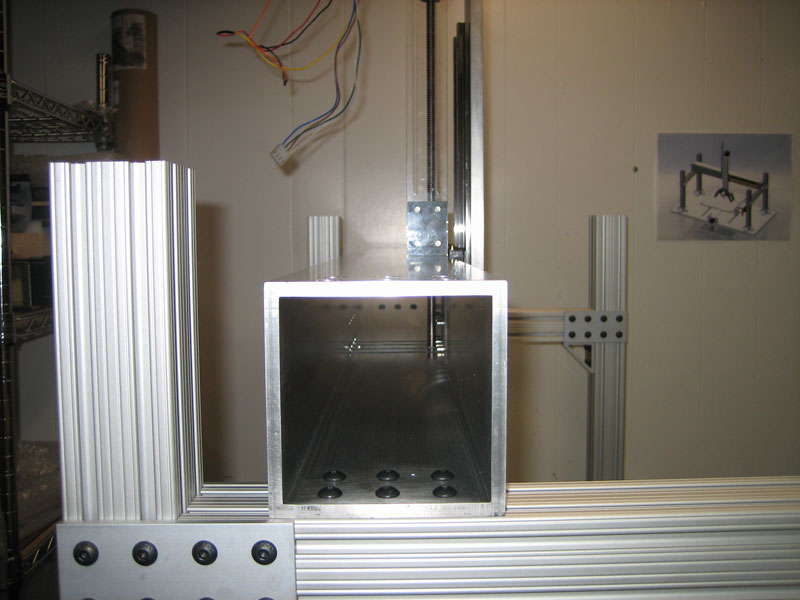
Z Beam Offset
The above image is a side view close-up of the offset for the Z Beam. The Z beam can be bolted directly anywhere on that 80/20 frame cross strut to accommodate for any size and shape tool head. Currently it is offset so the brass nozzle of the Plastic Extruder Tool Head is directly in the center of the build plate to maximize the build area.
The Z axis stage is basically identical to the Y axis stage for ease of assembly and in order to simplify part production. The only real difference between the two is that the Z axis stage has ten counter bored holes towards the end of the plate which are used for attaching various tool heads.
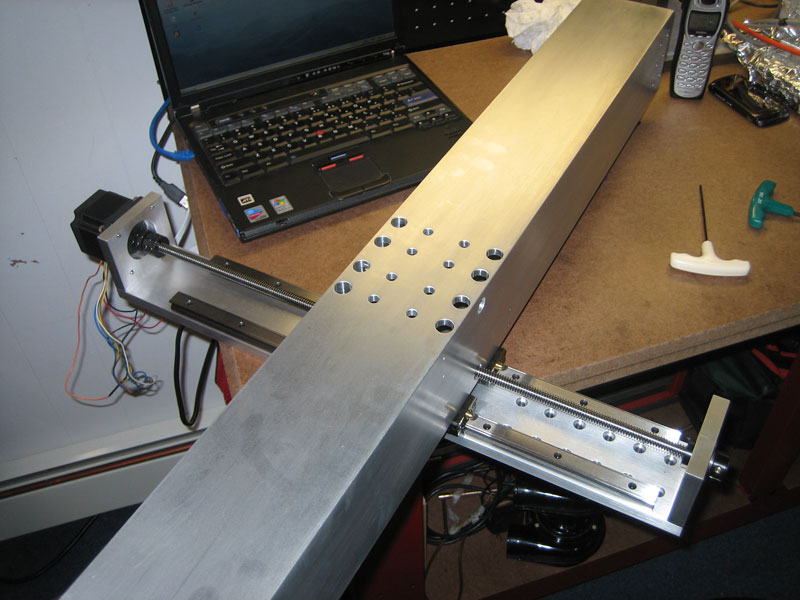
The Z axis stage mounted onto the Z beam
The Z axis stage uses four linear ball bearing blocks, two per each rail, as opposed to the X and Y stages which each use two. This was implemented in order to give the Z stage a larger degree of rigidity when subject to transverse loads. In the above image, the through holes on the Z beam are clearance for the screws that fasten into the linear bearing blocks. Speed is not an issue for the Z axis because it moves very small distances (~.425 mm) only intermittently (once per 3D printed layer). So, this stage uses 3/8″-12 (1 start) ACME threaded lead screws. This gives the Z axis a high resolution for traversing to each incremental layer while a part is being printed. Layer height is crucial when 3D printing high quality parts.
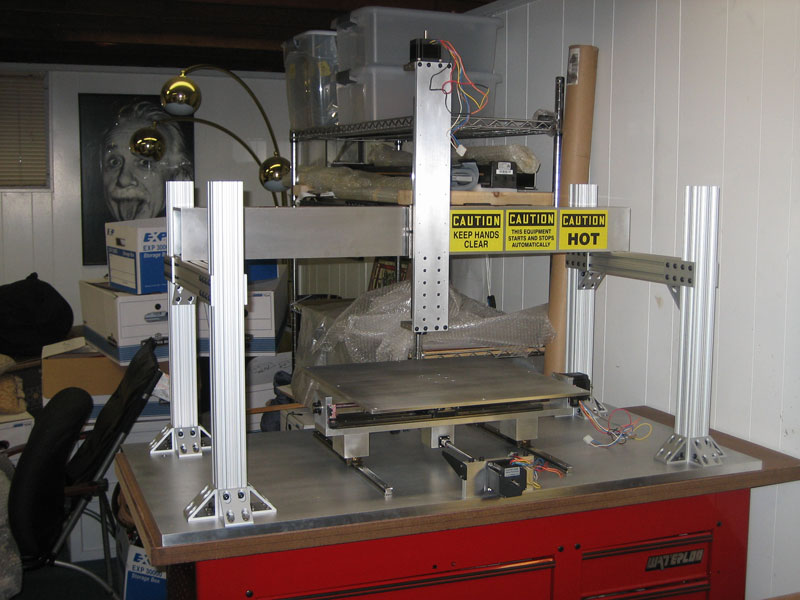
The Z axis stage and Z beam mounted on the 80/20 frame
Here the Z beam, with the newly attached Z axis stage, is mounted onto the Z axis support structure. Once again, the Z beam is positioned with laser cut jigs so that when the plastic extruder is attached, its nozzle will be perfectly centered over the build base.